

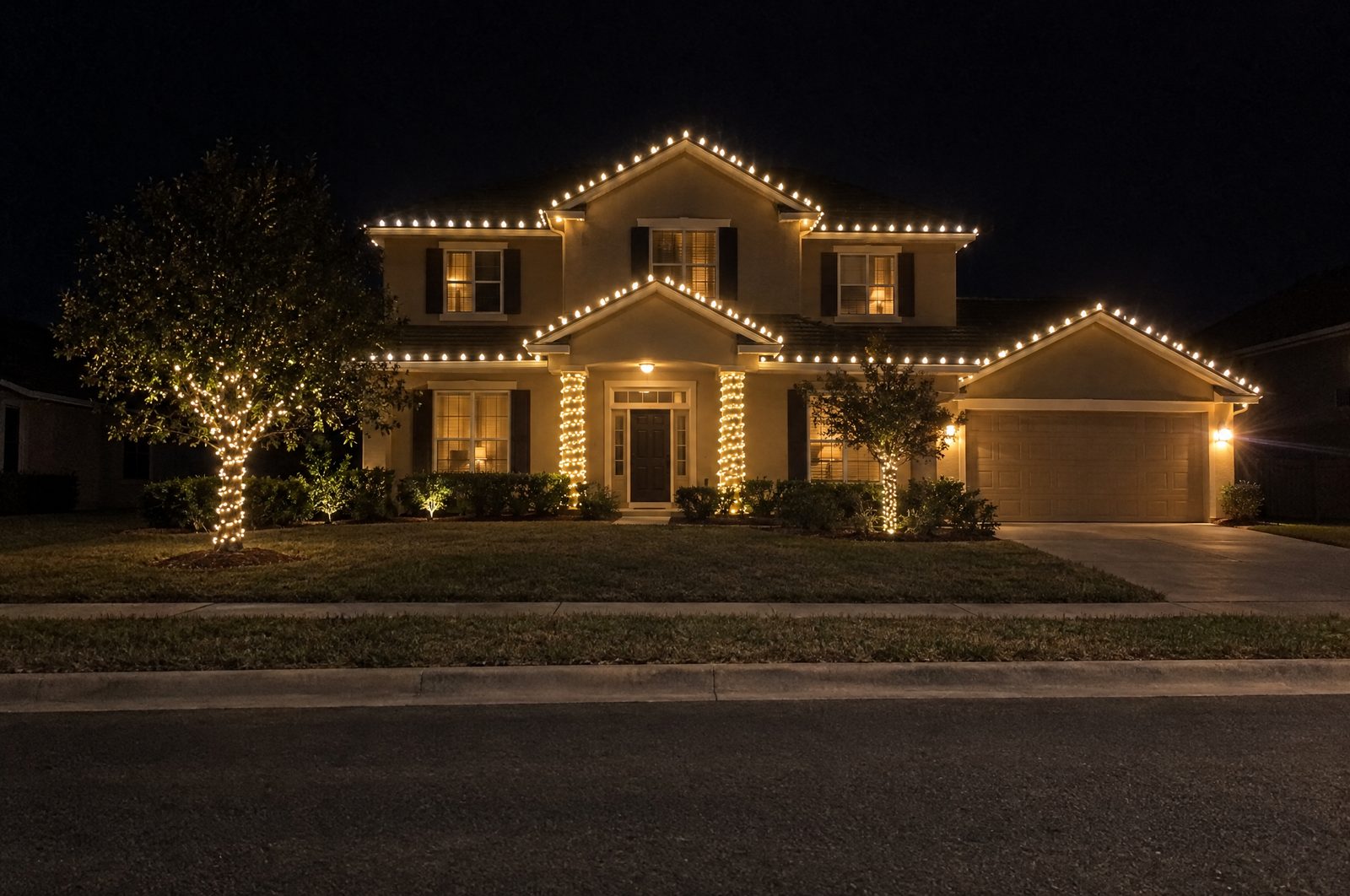
To hang Christmas lights on a roof line: measure the front edge in linear feet, pick C9 bulbs on a stringer cut to that length, then attach with clips that slide under shingles, clamp to the gutter lip or grab metal flashing. Work off a stable ladder from the ground, never the roof surface. Two stories, tile or steep pitches are where a pro install pays for itself.
How do you hang Christmas lights on a roof line?
The short version: measure, cut to length, clip, plug in. Learning how to hang Christmas lights on roof line edges is less about the lights and more about the attachment and the ladder work.
We run C9 LED bulbs along the gutter and fascia. They are heavier-looking than mini lights, they space evenly, and they read clean from the street at night.
What we skip
We do not hang icicle lights on rooflines. Nobody makes a commercial-grade icicle light that holds up. So it is C9 bulbs only on roof edges and peaks. When we say icicle drops in our service list, we mean drop lights hung from tree branches, not roofline icicles.
If you are buying a kit, count on more cord than you think. Corners, gable returns and the run back to the outlet eat length fast, and a strand that comes up two feet short at the far end is the part nobody enjoys.
How do you measure a roofline before you buy anything?
Measure in linear feet along the edge you want lit, not the slope. That number drives the strand length, the bulb count and the price.
We measure the roofline on satellite view, then confirm with photos the homeowner texts us. Most jobs we quote are front-facing only, with sides and back optional. More on that in our guide to getting a Christmas light quote.
- 1Pick the edges you want lit
Decide front only, or front plus a side the neighbors actually see. Lighting every edge of a house costs real money and often does not change the view from the road.
- 2Measure in linear feet
Run the tape along the ground parallel to each roof edge, or use a satellite map and measure edge to edge. Add the gable returns and short jogs.
- 3Add the run to the outlet
Measure from the end of your light run back to the nearest working outdoor outlet. A GFCI outlet near the lit area is what you want feeding it.
- 4Decide on peaks separately
Ridgelines are their own measurement and their own attachment problem. Price and plan them apart from the roof edge.
- 5Count your clips
Clip spacing follows bulb spacing, so one clip per bulb is the simple way to plan. Buy a few extra for corners and replacements.
Which Christmas light clips fit your roof?
The clip has to match the surface, not the light. Pick the wrong one and you are either prying at shingles or watching strands drop in the first windy week.
The four we use
- Shingle clips that slide up under the shingle edge and hold the bulb upright.
- Gutter clips that clamp over the front lip of the gutter.
- Flashing clips that grip metal drip edge or flashing.
- Tile: a shingle-style clip slides up under the tile where it fits.
No screws, no staples, no drilling, on any of it. More on surfaces in our stucco, tile and metal roof guide.
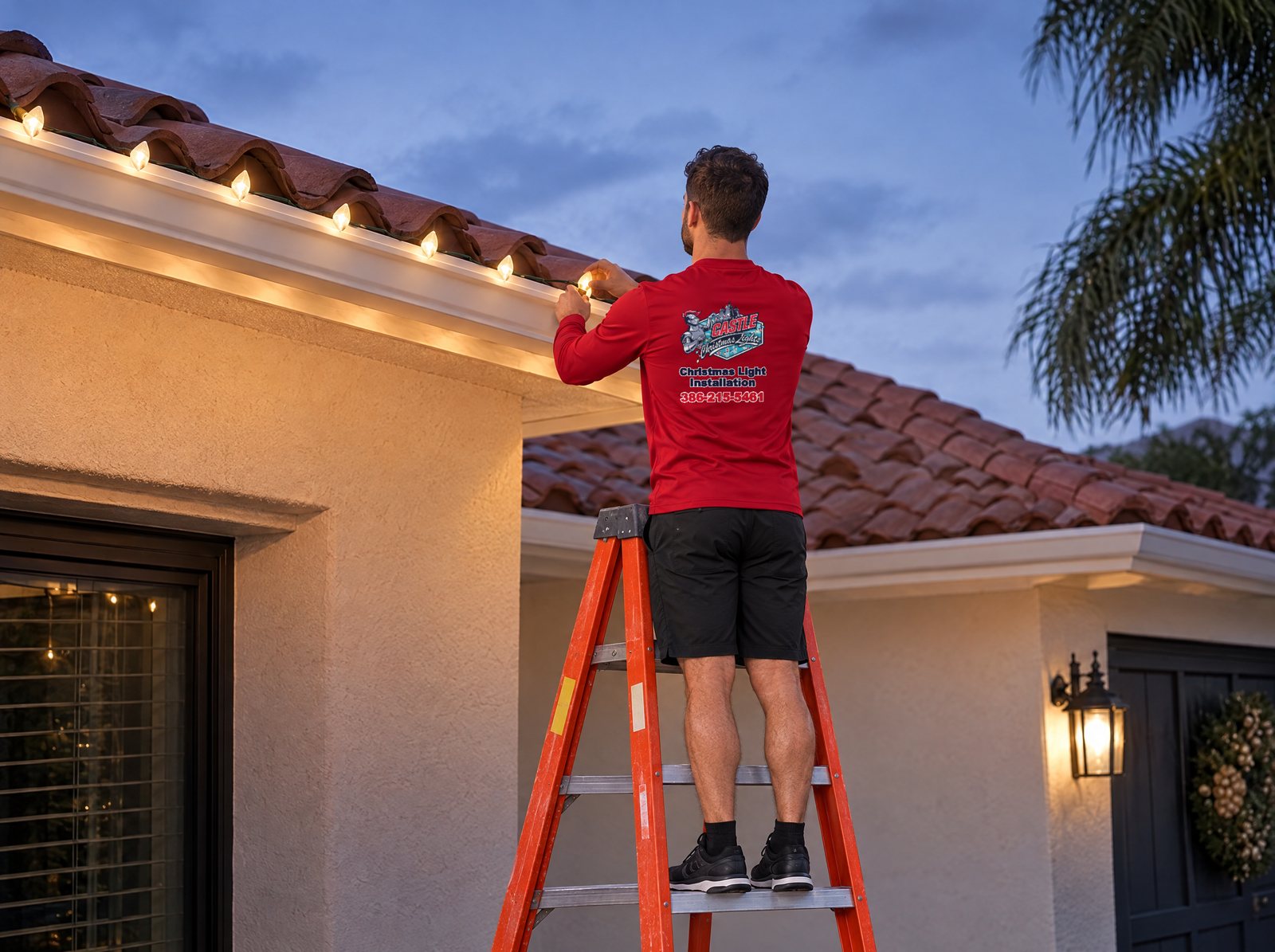
How do you hang Christmas lights without gutters?
No gutters is not a problem. You just move the attachment point to the shingle edge, the fascia trim or the metal flashing.
On a shingle roof with bare fascia, a clip that slides under the first course of shingles holds the bulb facing out and keeps the strand off the paint. On metal homes, flashing clips do the work. On tile, the clip goes up under the tile where there is room.
Things worth checking first
- Brittle or lifting shingle edges that do not want a clip slid under them
- Soft or rotted fascia board where nothing should be hung at all
- Leaf-filter style gutter guards, which have to come off and go back on around the lights
- Low-hanging branches sitting right on the roof edge
- A working outdoor outlet within reach of the run, GFCI preferred
- Whether the peak is part of the plan or just the edge
Want the roofline handled for you?
Send us a few photos of the front of your house and we will text back a same-day quote with lights, install, fixes and takedown included.
Get A Fast QuoteOr call/text 386-215-5461What about the roof peak and ridgelines?
Peaks are the part most people give up on, and honestly that is fair. The ridge is the highest point, the pitch is steepest right there, and there is no gutter lip to grab.
On shingle we clip to the ridge caps. On a tile ridgeline we often use a removable adhesive that comes off at the end of the season, because clips have nowhere to bite.
Ridge runs also cost more per foot than roof edges. We break the difference down in roofline vs. ridgeline vs. tree wrapping.
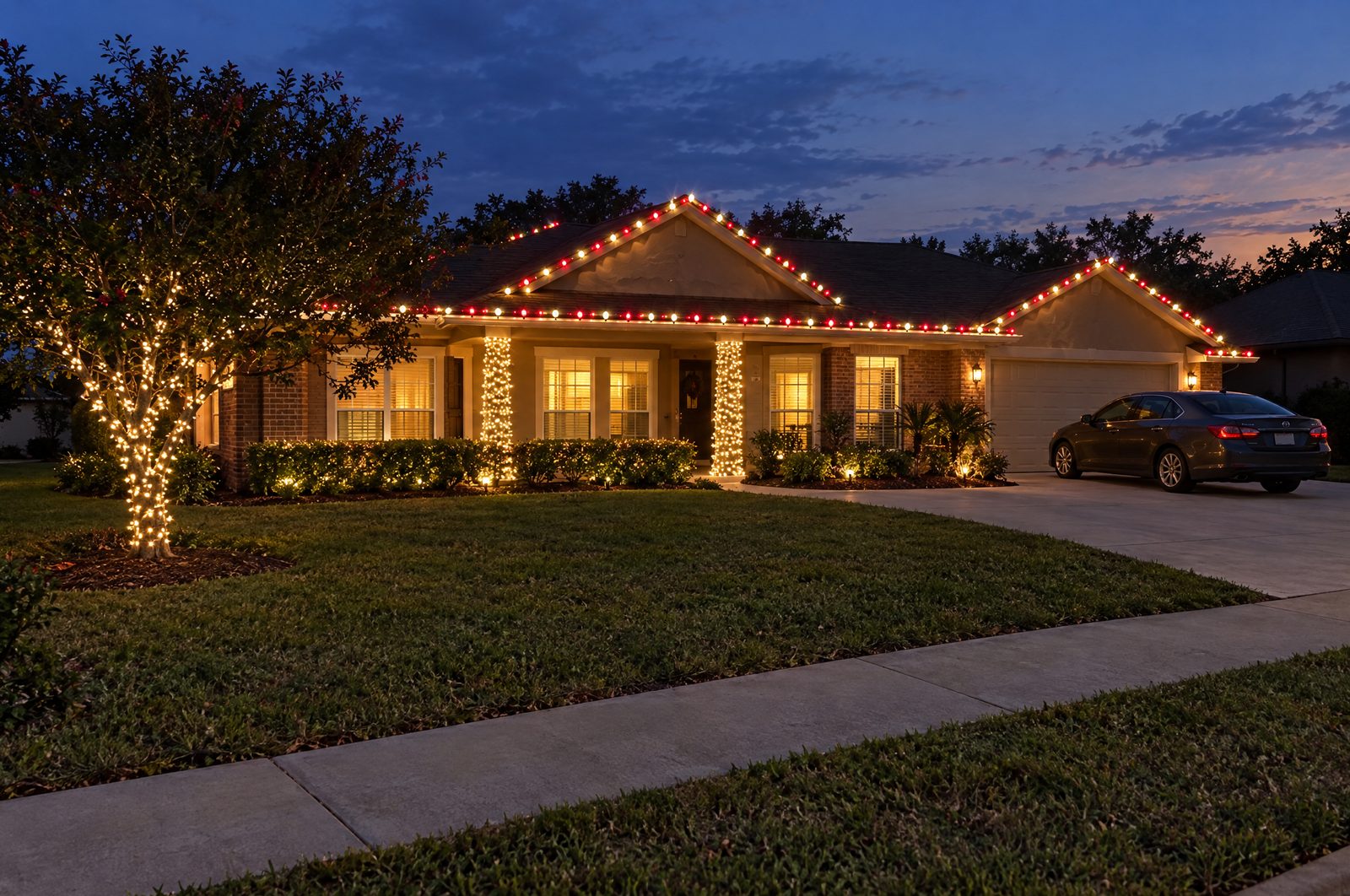
If you only light one thing beyond the roof edge, make it the main front peak. It gives the house a shape at night instead of a flat line, and it is the single change people notice most from the street.
What does safe ladder work actually look like?
The real risk on a roofline job is the ladder, not the lights. The goal is simple: work from the ladder, reach the edge in front of you, and move the ladder instead of leaning.
The basics
Level footing on solid ground, the ladder tall enough to clear the edge, and both hands free by keeping clips and strand in a pouch. Wet grass, soft sand and pavers that rock are all reasons to reset the feet.
Walking a Florida roof is its own risk. Tile cracks underfoot, and steep or two-story pitches are where DIY stops being a fair trade.
- Someone else home while you are on the ladder
- Ladder on firm, level ground with the feet set
- Clips and lights in a pouch so both hands stay free
- Move the ladder rather than reaching sideways
- Lights unplugged while you work the run
- A dry day, not the hour after a rainstorm
When does hiring a pro make more sense than DIY?
DIY works well on a single-story shingle roof you can reach from a ladder on flat ground. It gets rough fast on two stories, tile, steep pitch, or when you want the peaks lit too.
Here is how our pricing reads, lights included:
| Item | Price |
|---|---|
| Minimum display | $1,000 |
| Most single-story rooflines | $1,000 - $2,000 |
| Two-story homes | $1,500 - $2,500 |
| Roofline, per foot | about $7 |
| Ridgeline, per foot | about $10 |
Full breakdown on our cost page.
- You buy, store and replace the lights
- Strands get cut to fit by trial and error
- Ladder time on every outage all season
- Takedown and storage are on you in January
- Peaks and tile usually get skipped
- We own the lights; you never buy them
- Commercial-grade C9 LEDs custom cut to the house
- Insured crew, $2M liability plus workers' comp
- Free bulb and outage fixes all season once reported
- Takedown January 1-31 and off-season storage in labeled bins
What happens if you hand the roofline to us?
We are a seasonal rental: Castle Christmas Lights owns the lights, installs them, fixes them and takes them down. One price covers the design mockup drawn on a photo of your house, the lights, install, timers, in-season fixes and storage. It is best to leave the timers as we program them, and if anything looks off, call or text us.
Text us two to four clear photos of the front, or we pull it up on Street View and measure the roofline there. The quote form takes about a minute and we reply the same day by text.
We cover homes from Daytona Beach to Winter Park, including Deltona, Orange City and DeLand. Returning customers book first, and by mid-November we are usually booked into mid-December, so September or October is the easy window.
Frequently Asked Questions
A shingle clip that slides up under the edge of the shingle and holds the bulb upright is the standard choice. It needs no screws, staples or drilling, and it keeps the strand off the fascia paint. If the shingle edges are brittle or lifting, the fascia trim or metal drip edge is often the better attachment point instead.
Move the attachment to another surface. On shingle roofs, clips slide under the first course of shingles. On metal roofs and homes with drip edge, flashing clips grab the metal. On tile, a shingle-style clip slides up under the tile wherever it fits. Gutters are convenient, but they are only one of several places a clip can hold.
On a shingle roof, clips attach to the ridge caps along the top. On a tile ridgeline, clips have nothing to bite, so we often use a removable adhesive that comes off at the end of the season. Peaks sit at the highest and steepest part of the roof, so this is the element most homeowners hand off to a crew.
Measure each roof edge you want lit in linear feet along the ground, parallel to the edge, then add the gable returns and the run back to your outlet. Our rough guide for installed work is about $7 per foot for roofline and about $10 per foot for ridgelines, lights included, with a $1,000 minimum for any display.
On our installs, you let us know and we fix it free, usually within 72 hours once it is reported. Outages have to be reported to us, since we are not out there checking nightly. The problems we see in a Florida season are GFCI outlets tripping after heavy rain, wet outlets that will not reset, landscaper damage and squirrels chewing wire.
Get Your Christmas Light Quote
Answer a few quick questions. Our team texts you a same-day quote.
Get A Fast QuoteOr call/text 386-215-5461