

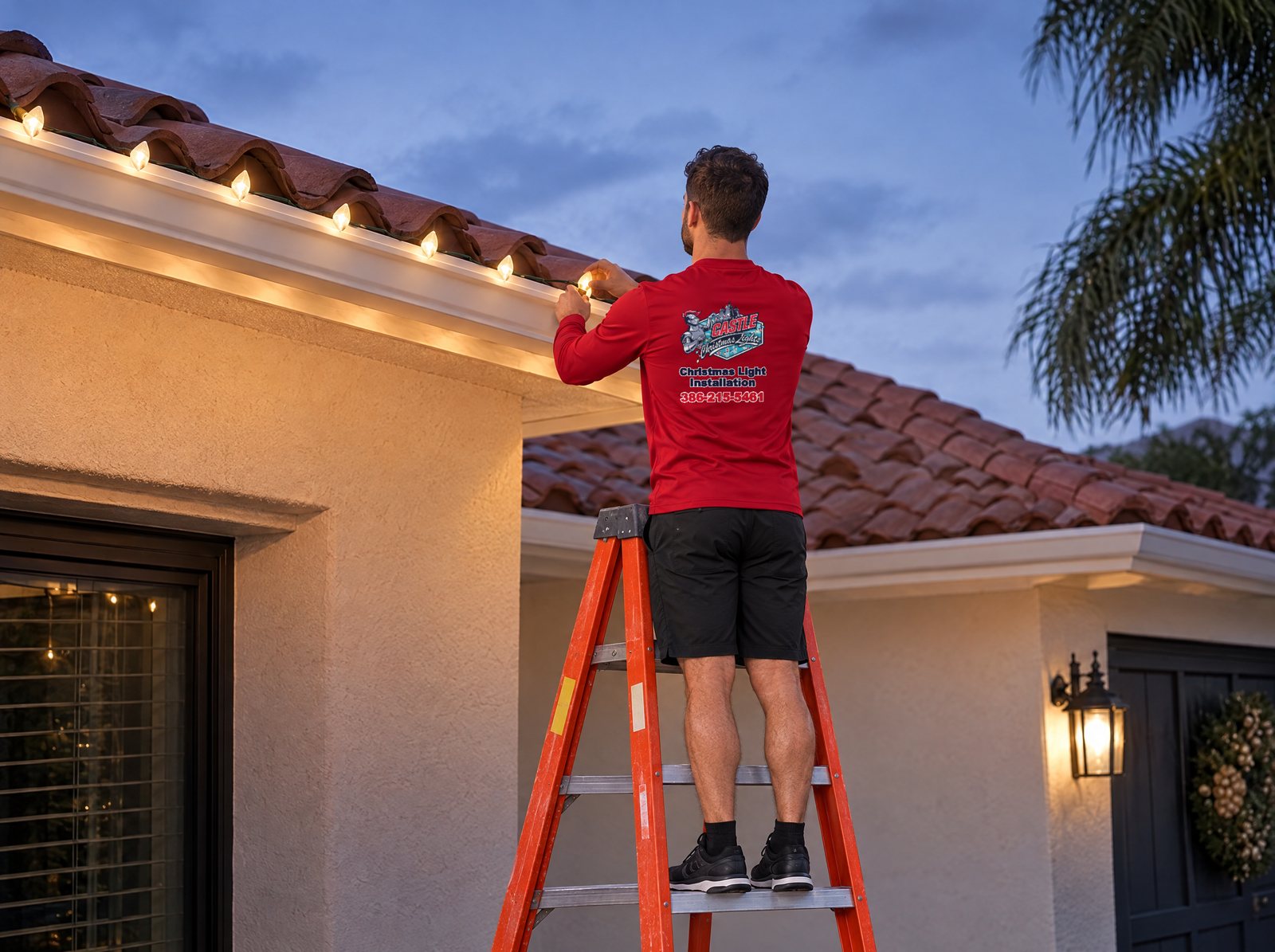
Professional installers never drill, screw or staple into stucco, tile or metal. Roofline lights ride the gutter and fascia on clips, tile gets clips that slide under the tile where they fit and a removable adhesive on the ridgeline that comes off in January, and standing-seam metal gets seam clips. Nothing leaves a hole, and Castle's contract spells out every attachment method before the crew arrives.
Florida homes are built out of stucco, barrel tile and, increasingly, metal — three surfaces that fight back against the plastic clips sold at the hardware store. Here's how professional installers attach Christmas lights to each one without drilling, staples or damage, and why the DIY version so often ends in a cracked tile.
Stucco walls
The first rule of stucco is don't puncture it. Nails, screws and staples open the moisture barrier behind the finish, and a season of afternoon storms will find the hole. Professionals don't attach lights to the stucco itself at all. Roofline lights ride the gutter or the fascia board; window and column outlines use removable clips designed for stucco, or are skipped in favor of lighting the architecture from the roofline and the landscaping. If a homeowner insists on outlining an arch or a column, a pro uses hooks that leave no mark and removes them in January.
Barrel and flat tile roofs
Tile is where most DIY attempts fail. Standard gutter clips don't fit under a barrel tile, so people improvise with heavier clips that stress the tile edge, or worse, walk the roof to run lights along the ridge. Tiles crack under foot, and a cracked tile is a leak.
On tile we have two ways to attach, and neither one involves a drill. Where a shingle-style clip can slide up underneath the tile, we use that. Where it can't, which is most often along the ridgeline of a tile roof, we use a removable adhesive made for the job: it holds through the season and comes off at takedown in January. No screws, no staples, no holes. We also keep the crew's weight off the tiles wherever possible by working from ladders and lifts. Ridgeline lighting on tile is a job for people who do it every day, which is why it's priced a little higher than roofline — our working figures are about $7 a foot for roofline and $10 for ridgeline, lights included.
Metal roofs
Standing-seam and 5V metal roofs are common on newer coastal homes and older Florida cottages alike. Nothing gets drilled. Clips designed for standing seams grip the seam; on 5V and corrugated profiles, lights typically follow the gutter or fascia instead of the roof surface. Metal also runs hot in the sun, which is one more reason to use commercial-grade LED strands on heavier-gauge wire rather than retail strands that soften and sag.
It's worth asking any installer how they'll reach a ridgeline on barrel tile. Tiles can crack under foot, and a cracked tile is a leak you find in the next storm. We work from ladders and stay off the field of the roof wherever we can.
Gutters and fascia: where most of the lights actually go
On every roof type, the clean outline you see from the street is mostly along the gutter and fascia line. Gutter clips snap onto the lip; fascia clips grip the board where there's no gutter. Neither leaves a hole. The lights run in a continuous, evenly spaced line because the crew installs one commercial product on one wire gauge, not a mix of strands from different years.
Why DIY clips fail in Florida
- Plastic goes brittle after one Florida summer and snaps the next December
- Cheap metal hooks and connector pins corrode near the coast within a season
- Loosely clipped strands blow off the gutter in an afternoon storm
- Nothing on the shelf fits under a barrel tile
- Clips that slide under or clamp to shingles, clip onto gutters, or connect to metal flashing
- On tile: clips that slide under the tile where they fit, and a removable adhesive on the ridgeline that comes off in January
- Commercial-grade LED strands on heavier-gauge wire that hold in wind
- Nothing drilled, nothing stapled, nothing left behind in January
What this means when you're comparing installers
Ask exactly how the installer will attach lights to your tile, stucco or metal. "Clips" isn't an answer; "tile clips on the first course, gutter clips on the fascia, nothing drilled, we work from ladders" is. Castle's residential contract spells out the attachment methods we use and the rare ways any roof hardware can mark a surface, because we'd rather you read it than be surprised.
Step by step: a professional install on a tile-roof home
- 1Design first
The mockup is drawn on photos of your house, so the crew knows before arriving which runs are gutter, which are fascia, which are tile-edge and which are ridgeline.
- 2Power plan
Outlets are identified and the display is split into circuits so no single run is overloaded. Timers are set at the outlet, not on the roof.
- 3Roofline from ladders
Gutter and fascia clips go on from the ladder, one bulb per clip at fixed spacing, so the line reads straight from the street.
- 4Tile edges and ridgelines
Clips slide up under the tile where they fit. Ridgeline runs on tile are usually held with a removable adhesive that comes off at the end of the season, placed by crew members trained to work on tile without loading the wrong spots.
- 5Trees, shrubs and walkways
Mini lights wrap trunks and limbs; pathway lights stake along the drive; everything ties back to the same timers.
- 6Test at dusk
The display is switched on, checked for dark spots and left on its timer. If anything fails during the season, the fix is free.
If your gutters have leaf-filter style guards, it helps to mention it before the quote. The guards have to come off and go back on around the lights, and that changes the price. Nobody likes finding that out on install day.
What about Florida's trees and landscaping?
Stucco and tile get the attention, but a Central Florida lot has its own quirks. Palms are wrapped from the trunk up, never with anything that constricts the trunk. Live oaks with wide canopies take icicle drops beautifully but need ladders and lifts rated for the height. Shrubs and beds are lit with net or mini lights that don't crush new growth, and the contract notes that as plantings grow, we may add lights at our discretion and bill accordingly. Pathway lights are staked, not glued, so pavers and driveways aren't marked.
Tile Roof? Stucco? Metal? We've Hung Lights On All Of It.
Tell us your roof type in the quote form and the crew arrives with the right clips.
Get A Fast QuoteOr call/text 386-215-5461Tile and stucco are especially common in New Smyrna Beach, Ormond Beach and Lake Mary. Learn more about our residential installation or check pricing.